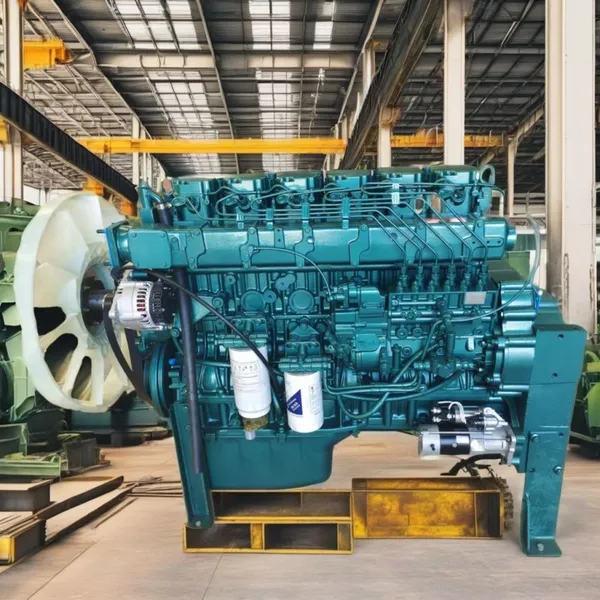

 Business License

DEUTZ BF6M1015 Engine Specifications: Bore, Stroke and Rating Tables
A pump station in southern Europe ordered a replacement engine against a specification sheet copied from an old quotation, and the sheet carried a bore and a stroke figure that belonged to a different member of the same series. The engine that arrived fitted the frame and drove the pump at the duty the plant needed, and the maintenance schedule behind it had been built on the wrong displacement. The error surfaced a year later when the wrong liner set was ordered against the record.
Specification sheets travel further than the engines they describe, and a single wrong figure propagates into every document built on top of it.
This article sets out the DEUTZ BF6M1015 engine specifications worth holding in hand, explains why the BF6M1015 bore and stroke matter more than the peak figure, and shows how to build a BF6M1015 engine rating table that survives contact with a real site. It is written for buyers, plant engineers and maintenance planners.
1. What the DEUTZ BF6M1015 Engine Specifications Cover
The DEUTZ BF6M1015 engine specifications divide into three groups, and each group answers a different question.
The physical group describes the block: cylinder count, layout, bore, stroke and total displacement. The performance group describes what the engine does with that displacement: rated output, rated speed and torque. The installation group describes what the engine needs around it: cooling capacity, airflow, exhaust sizing and mounting points.
Buyers tend to collect the second group and skim the other two, which is the wrong order. Displacement and bore decide what the performance group can be, and the installation group decides whether the performance can be held in the room the engine occupies.
A specification sheet is useful when the three groups agree with each other. A rated output quoted without a rated speed is not a specification, and a torque figure quoted without a speed at which it occurs describes nothing.
Pinbo Power keeps the three groups together in the quotation so a buyer can check the physical figures against the performance figures before comparing prices.
2. BF6M1015 Bore and Stroke: The Figures Behind Displacement
The BF6M1015 bore and stroke are the two numbers that generate everything else on the sheet.
Bore is the diameter of the cylinder, and stroke is the distance the piston travels between its two extremes. Multiplying the area of the bore by the stroke gives the swept volume of one cylinder, and multiplying that by six gives the displacement of the engine.
A long stroke layout, where the stroke exceeds the bore, produces torque at lower engine speeds and suits machinery that has to start against a load. A short stroke layout produces its output higher in the speed range and suits applications that run fast and light.
The table below sets the two figures against the rest of the physical specification. Read the values as typical for the family, because builds vary with rating and application.
| Physical figure | Typical value | Why it matters |
|---|---|---|
| Cylinder count | Six | Torque smoothness and load balance |
| Bore | roughly 132 mm | Sets the swept area per cylinder |
| Stroke | roughly 145 mm | Long stroke biases torque to low speed |
| Displacement | roughly 11.9 litres | Ceiling on torque without high boost |
Those four rows explain why two engines of similar output can behave very differently in the same frame. The larger displacement reaches its figure with less boost and less heat to reject.
Where a plate or a build record differs from the figures above, the plate governs. Bore and stroke describe a family, and the suffix describes the unit in front of you.
3. A BF6M1015 Engine Rating Table by Duty Class
A BF6M1015 engine rating table is meaningful when it carries a duty class against every row.
The same block is offered at a continuous figure, at a heavier industrial figure and at a standby figure, and the three are not interchangeable. Continuous ratings suit sets that carry a plant as their main supply, while standby ratings suit sets that run rarely and have to start on demand.
The gap between the classes is not a matter of marketing margin. Fuel delivery, governed speed and the cooling package change with the class, so a unit set for one duty and used for another runs outside the band it was built for.
The table below sets out the class structure a buyer will meet. The output figures are indicative and belong to the family rather than to a particular build.
| Duty class | Indicative output | Governed speed | Typical use |
|---|---|---|---|
| Continuous | mid range of the series | 1,500 or 1,800 rpm | Prime power, process plant |
| Heavy industrial | upper mid range | matched to the driven machine | Crushers, compressors, pumps |
| Standby | highest of the three | 1,500 or 1,800 rpm | Backup power for critical sites |
Speed matters as much as output on a generator drive, because the alternator produces its frequency at one governed speed. A rating table that omits speed cannot be checked against the alternator it will serve.
4. Reading a DEUTZ BF6M1015 Engine Specifications Sheet
Reading a specification sheet is a matter of working in order rather than of reading top to bottom.
Start with the physical group and confirm the cylinder count, the bore, the stroke and the displacement together. If those four figures do not multiply out to the quoted displacement, the sheet has been assembled from more than one source.
Then move to the performance group and check that every figure carries the condition under which it applies. Rated output belongs with a rated speed, torque belongs with the speed at which it peaks, and fuel consumption belongs with a load point.
Finish with the installation group and compare its airflow and heat rejection figures against the room the engine will occupy. This is the step buyers skip, and it is the one that explains most installations that fail in their first hot season.
Pinbo Import and Export sends the three groups on one sheet rather than in separate documents, so the check can be made in a single pass.
5. Compression, Aspiration and the BF6M1015 Bore and Stroke
Compression ratio and aspiration sit between the BF6M1015 bore and stroke and the performance the engine delivers.
Compression ratio describes how far the charge is squeezed before ignition, and on a turbocharged industrial engine it typically lands near 17 to 1. A higher ratio improves cold starting and thermal efficiency, while a lower ratio leaves more room for boost.
Aspiration decides how much air reaches the cylinder in the first place. A turbocharged build adds boost and gains output from the same displacement, and an aftercooled build cools the charge before it enters the manifold and gains more again.
That extra air is what lets a longer stroke deliver more torque at low speed. The two design choices work together, which is why a specification sheet that lists one without the other cannot be evaluated on its own.
The practical consequence for a buyer is that displacement sets the ceiling and aspiration decides how close to that ceiling the build sits.
6. Building a BF6M1015 Engine Rating Table for a Project
Building a rating table for a project starts from the load rather than from the engine.
List the steady load, the largest load step and the design ambient temperature, then place them against the duty classes the series offers. A set sized on steady load alone will hold the plant in normal running and struggle at the moment a large motor is switched in.
Add the altitude of the site, because air thins with height and the output an engine can deliver falls with it unless the fuel setting is adjusted. A site above roughly a thousand metres belongs in the derated category.
Then confirm the installation figures. Heat rejection to the coolant, combustion air demand and exhaust back pressure all have to be matched to the room and the pipework, and each of them is easier to arrange at the design stage than after the set has been placed.
Pinbo Power builds the table with the customer so the figures on it can be traced back to the site conditions rather than to a previous project.
7. Torque, Fuel and Heat in the DEUTZ BF6M1015 Engine Specifications
Torque, fuel burn and heat rejection are the three DEUTZ BF6M1015 engine specifications that decide how the unit feels in service.
Torque on a long stroke industrial engine arrives low in the speed range, and torque rise above the rated point is what lets the engine recover when the load increases. A flat torque curve with little rise produces an engine that sags under a step and takes time to catch up.
Fuel burn is normally quoted as a specific figure at a stated load point, and it climbs quickly once the engine is worked above the band it was calibrated for. A single number without a load point is not comparable between two engines.
Heat rejection to the coolant is the figure that sizes the radiator and the room ventilation, and it is the one most often left off a quotation. Without it, the cooling package becomes a guess and the guess is usually low.
Ask for all three in writing. They are the figures that turn a specification sheet into something a plant engineer can design around.
8. How to Check a BF6M1015 Engine Rating Table Against a Machine
Checking a rating table against a machine is a short exercise when the inputs are already written down.
Confirm that the rated speed matches the governed speed the driven machine needs, then confirm that the duty class matches how the machine will actually be used rather than how it was originally specified.
Compare the heat rejection figure against the radiator and the room, and the combustion air figure against the vents. A table that passes the first two checks and fails these two produces an engine that runs well in winter and loses temperature control in summer.
Finish by checking the mounting and coupling details. Flywheel housing, coupling type and mounting points decide whether the engine can be installed without reworking the frame.
Jining Pinbo Import and Export Co Ltd works through the same four checks with the customer before an order is confirmed, which is why the sheet and the site are settled in one exchange rather than several.
9. Frequently Asked Questions
9.1 Why do BF6M1015 bore and stroke matter more than the peak rating?
The BF6M1015 bore and stroke set the swept volume, and swept volume sets the ceiling on how much torque the engine can produce without high boost. A larger displacement reaches a given torque with less strain and less heat to reject, while a smaller one works harder across the same duty cycle. The peak rating describes one point on the curve and says nothing about how much margin remains below it. Buyers who compare engines on peak output alone tend to discover the difference after the machine has been working for a season.
9.2 What has to be on a BF6M1015 engine rating table?
A usable BF6M1015 engine rating table carries a duty class against every row, because a continuous figure and a standby figure for the same block are not interchangeable products. Each row then needs an output figure with the speed at which it applies, and ideally a torque figure with its speed. Where the engine drives an alternator, the governed speed is fixed by the frequency the alternator must produce, so it belongs on the table as well. Without those columns, two quotations cannot be compared on anything except the headline number.
9.3 Which DEUTZ BF6M1015 engine specifications should a quotation include?
A quotation should carry the DEUTZ BF6M1015 engine specifications in three groups rather than as a single line. The physical group covers cylinder count, bore, stroke and displacement, the performance group covers output, speed and torque, and the installation group covers heat rejection, combustion air demand and exhaust sizing. The installation group is the one most often omitted and the one that explains most early failures. Ask for all three before comparing prices, because a lower figure that leaves out the cooling package is not a lower cost.
9.4 Can the DEUTZ BF6M1015 engine specifications be matched to an existing installation?
They can, and the work sits in the installation group rather than in the engine itself. Heat rejection, combustion air demand and exhaust back pressure have to be checked against the radiator, the vents and the pipework already in place, because those three decide whether the unit can hold its rating in the room it occupies. Mounting points and coupling details then decide whether it fits the frame without rework. Where the existing cooling package is tired, matching the new specification to a new radiator is usually part of the same job rather than a separate one.
Recently Posted
-
DEUTZ F3L912 Engine Specifications and Air-Cooling Limits
November 3, 2026A workshop rebuilt a three cylinder air cooled engine to the figures printed on an old data sheet, then put it back into a machine Read More
-
6CTA8.3-C260 Engine Specifications and Power Ratings Explained
November 3, 2026A tender went out for two replacement engines in a marine auxiliary role, and three suppliers returned three different torque figu Read More
-
Buying a VOLVO D8H Engine: What to Confirm Before Ordering
November 2, 2026Buying a VOLVO D8H engine is mostly a matter of confirming things in the right order, because the unit itself is well established Read More
-
How to Source a VOLVO D7E Engine: Identification and Ordering
November 2, 2026Sourcing a VOLVO D7E engine is a different exercise from buying a mechanical industrial unit, because a large part of what identif Read More

Contact Us
Recommended Products
-
 New 129 kW QSB6.7 Diesel Engine Excavator Construction Machinery Electric Start Water-Cooled Core Including Motor PumpUS$ 1888.00 - 3888.00MOQ: 1 Unit
-
Wholesale Diesel Engine Genuine 4 Stroke Direct Injection Doosan DL08 Engine for SaleUS$ 4558.00 - 4800.00MOQ: 1 Unit
-
Factory Price DOOSAN DL06 Construction Machinery Motor 6 Cylinder 115kw Water-Cooled With Core Components Engine and PumpUS$ 4752.00 - 5000.00MOQ: 1 Unit
-
Factory Price 4 Stroke 115kw Doosan DB58 Complete Engine Assy for Dx220 ExcavatorUS$ 3450.00 - 3650.00MOQ: 1 Unit
-
Factory Manufacture 123kw 4 Stroke Volvo D6e Machinery Engine for Construction MachineryUS$ 7500.00MOQ: 1 Unit
-
New BF6M2012C Cylinder 4-stroke Original Water-cooled Generator With Live Start FunctionUS$ 4500.00 - 5400.00MOQ: 1 Unit
-
Original Water Cooled 4 Stroke 6 Cylinder DEUTZ TCD2012062V Machinery EnginesUS$ 4888.00 - 5081.00MOQ: 1 Unit
-
Factory Outlet 6 Cylinder 250HP 2200rpm 6C8.3-C250 Construction Machinery Engines for CuminsUS$ 34627.00 - 36450.00MOQ: 1 Unit
-
1104D-44TA Diesel Engine 83kw New Water-Cooled Machine With Electric Start and Pump Good Price Per UnitUS$ 3700.00 - 4200.00MOQ: 1 Unit
-
Original Water Cooled 4 Stroke DEUTZ TCD 2013 L06 2V Machinery Engines for SaleUS$ 7070.00 - 7443.00MOQ: 1 Unit
-
Excavator Engine Assy QSL8.9 Complete Engine Assembly CUMMINS Qsl 9 Diesel EngineUS$ 4300.00 - 4600.00MOQ: 1 Unit
-
Genuine Vovo D4d EAE2 Diesel Engine for VOLVO EC140 ExcavatorNegotiableMOQ: 1 Unit
-
Factory Outlet 6 Cylinder 250HP 2200rpm 6C8.3-C250 Construction Machinery Engines for CuminsUS$ 4700.00 - 5100.00MOQ: 1 Unit
-
Good Price 153kw 4 Stroke Electric Start D7E Diesel Engine for Construction MachineryUS$ 8350.00MOQ: 1 Unit
-
WEICHAI 178kw 4 Stroke WD10G240E203 Diesel Engine for SEM660D SEM660B Wheel LoaderUS$ 3920.00 - 4127.00MOQ: 1 Unit
-
Dongfeng Shanghai SC11CB220G2B1 6-Cylinder Diesel Engine 162kw (220hp) SDEC 3306 New Condition Core Included Farm MachineryUS$ 6500.00MOQ: 1 Unit
-
ISUZU 4 Cylinder Diesel Engine 4BG1 Machinery Engines for Kobelco SK135 ExcavatorUS$ 6800.00MOQ: 1 Unit
-
130Hp Diesel Engine YC4D130 Yuchai Diesel Motor Price for TruckUS$ 3400.00 - 3600.00MOQ: 1 Unit
-
Shanghai SDEC SC9D220G2 162KW Diesel Engine for SEM922 SEM921 GraderUS$ 5320.00 - 5600.00MOQ: 1 Unit
-
Factory Outlet Sinotruk D1242 Engine Assembly for Construction IndustryUS$ 4615.00 - 4858.00MOQ: 1 Unit