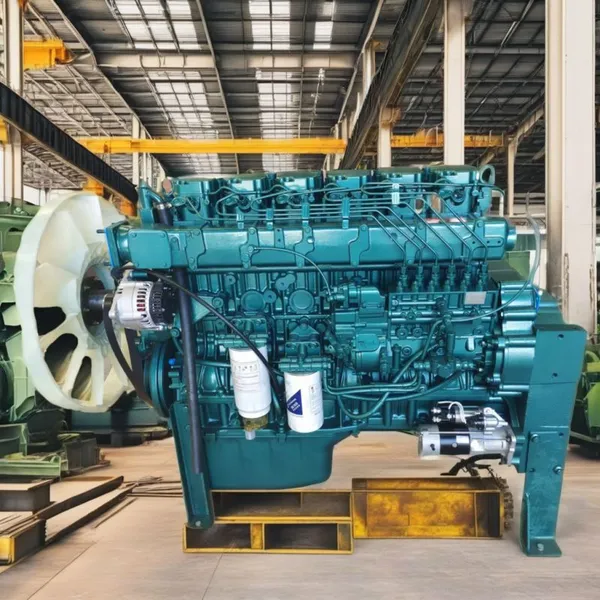

 Business License

Cummins 6CTA8.3-C260 Engine Naming and Family Explained
A workshop in southern Europe ordered a replacement engine by copying the letters from a worn plate that read 6CT8.3, and the unit that arrived fitted the frame and matched the bellhousing. It also ran hotter than the engine it replaced, because the original plate had lost the two characters that recorded an aftercooler and a rating band. The workshop spent a fortnight chasing a cooling fault that had been ordered in at the counter.
Model strings in this family follow a fixed order, and each position answers a different question about the engine that carries it.
This article walks through the 6CTA8.3-C260 engine model code character by character, explains how the Cummins C series engine family is organised, and sets out the 6CTA8.3 diesel engine naming rules that decide which unit belongs in which machine. It is written for buyers and fleet engineers who have to read a plate rather than trust a listing.
1. How to Read the 6CTA8.3-C260 Engine Model Code
The 6CTA8.3-C260 engine model code reads left to right as a description of the engine rather than as a serial number.
The first figure gives the cylinder count, so the six tells you the unit is an inline six before any other character is considered. The C that follows names the block family, which in this case is the C series of 8.3 litre engines.
The next two letters describe the air path. A T marks a turbocharger, and an A marks an aftercooler that sits between the turbocharger and the intake manifold. The displacement then follows the letters as a decimal figure in litres.
The suffix after the dash is a rating label rather than a piece of hardware. In this code the C260 records a 260 horsepower calibration, and the same block leaves the line under other suffixes when the fuel system is set for a different band.
Read in that order, a plate answers three questions at once: the size of the engine, the way it breathes, and the band it was calibrated for. A buyer who stops after the displacement has half an engine description in hand.
2. What Each Letter in the 6CTA8.3 Diesel Engine Naming Rules Means
The 6CTA8.3 diesel engine naming rules are consistent across the family, which is what makes the code worth learning once.
Numbers in the prefix describe physical size and cylinder count, and letters describe aspiration and cooling. Digits in the suffix describe output, and a trailing character can mark a build revision.
The table below sets the positions against their meaning. Treat it as a guide to the family rather than as a substitute for the plate on a specific engine.
| Position | Character | What it records |
|---|---|---|
| 1 | 6 | Six cylinders |
| 2 | C | C series block family |
| 3 | T | Turbocharged |
| 4 | A | Aftercooled |
| 5 to 7 | 8.3 | Displacement in litres |
| Suffix | C260 | Rating calibration for a 260 horsepower band |
A buyer with the code table in hand can spot a mismatch between a description and a machine in seconds. A listing that shows a 6CT8.3 plate on an engine described as aftercooled is describing two different units.
The same order governs the smaller and larger members of the family, so the reading skill transfers. Once the sequence is known, a longer or shorter 6CTA8.3-C260 engine model code can be decoded without a reference sheet.
3. Cummins C Series Engine Family: Displacement and Aspiration Variants
The Cummins C series engine family is built on a small number of blocks, and the variants around them are what a buyer has to separate.
Displacement divides the family into a few bands, and aspiration divides each band again into naturally aspirated, turbocharged and turbocharged aftercooled builds. The 8.3 litre block spans all three aspiration types, which is why the letters in the middle of a code matter as much as the numbers.
A naturally aspirated member breathes at atmospheric pressure and produces the least output from a given displacement. A turbocharged member adds boost and gains output without changing the bore or the stroke. A turbocharged aftercooled member cools the charge air after the turbocharger and gains the most of the three.
The three builds share a bore of roughly 114 mm and a stroke of roughly 135 mm in the 8.3 litre form, and they still behave differently in a machine. The hardware arranged around the block, rather than the block itself, decides the duty each one can hold.
| Aspiration | Code marker | Typical output from 8.3 litres |
|---|---|---|
| Naturally aspirated | no T or A | roughly 180 hp |
| Turbocharged | T | roughly 215 to 225 hp |
| Turbocharged aftercooled | TA | roughly 240 to 260 hp |
Those figures describe the family rather than a single engine. Plates vary with build specification and application, and the suffix at the end of the string is the part that settles a particular unit. Pinbo Power keeps the common build references on file so a suffix can be checked against the application it is meant to serve.
4. Where the C260 Rating Sits in the Cummins C Series Engine Family
The C260 suffix places one engine near the top of the family's intermittent range.
Ratings inside a family are grouped by duty rather than by hardware. An intermittent rating suits machines that cycle between load and no load, and a continuous rating suits machines that hold one speed for hours. The C260 label records the higher of the two bands, which is why it turns up in loaders, excavators and crushers rather than in generator sets.
Lower suffixes on the same block are calibrated for lighter duty, and their fuel delivery, injection timing and governor settings differ from the C260 build. Two engines with identical blocks can therefore carry plates that are 40 to 50 horsepower apart.
A buyer who compares engines on the block alone misses that split. The Cummins C series engine family offers several ratings per displacement, and the suffix is the most reliable record of which one a machine received.
Reading the suffix also protects the cooling package. A unit calibrated for standby duty and fitted to a machine that digs will reject more heat than the radiator behind it was sized to carry.
5. 6CTA8.3-C260 Engine Model Code Suffixes and Duty Bands
Suffixes are the part of the 6CTA8.3-C260 engine model code that buyers misread most often.
A suffix records a calibration rather than a component. The same 8.3 litre aftercooled block appears under more than one suffix depending on the band set at the factory, so a suffix cannot be treated as a model number in its own right.
The table below groups the suffixes a buyer is likely to meet on this block and the duty each one serves.
| Suffix band | Typical output | Common duty |
|---|---|---|
| Lower rating | roughly 180 to 220 hp | Standby power, light pumping |
| Mid rating | roughly 225 to 245 hp | Intermittent construction work |
| C260 | roughly 260 hp at 2,200 rpm | Cyclic digging and lifting |
A plate that carries no readable suffix leaves the buyer guessing, and guessing in this family is costly. Ask for a photograph of the plate rather than a transcription from the seller, because one character changes the answer.
Duty bands also decide the governor and the cooling package. A unit set for standby duty and fitted to a machine that digs will hold its speed less firmly and send more heat to a radiator than that radiator expects.
6. Aspiration Letters in the 6CTA8.3 Diesel Engine Naming Rules
The aspiration letters do the most work of any position in the 6CTA8.3 diesel engine naming rules.
A T on its own means the engine is turbocharged and breathes air compressed by an exhaust driven turbine. An A placed after the T means the compressed air is then cooled before it enters the manifold, which raises the density of the charge and lowers the temperature at the end of the compression stroke.
That extra letter changes the cooling load on the machine. An aftercooled build sends more heat to the coolant and needs a radiator with more capacity, so a repower that reuses the old cooler runs out of margin early in the season.
The letters also change how the engine behaves in hot air. A cooled charge lets the fuel system deliver more fuel before the exhaust temperature limit is reached, which is why aftercooled members of the family hold their rating better at high ambient temperature.
7. A Family Map: Cummins C Series Engine Family Across Applications
The Cummins C series engine family reaches across applications because the same block scales through several ratings and aspiration types.
In construction the family appears in wheel loaders, excavators, backhoes and crushers, where cyclic duty and dust dominate. In power generation it appears at the lower continuous ratings, driving generator sets for industrial sites and standby systems. In marine work it turns up as propulsion in workboats and as auxiliary power on larger vessels.
Each application imposes a different heat load and a different service interval on the same basic hardware. A loader asks for repeated torque spikes and a radiator that copes with dust, while a generator set asks for one speed held steady for hours and a cooling package built for continuous heat soak.
Jining Pinbo Import and Export Co Ltd keeps the housing, coupling and cooling combinations for common loader and generator frames on file, which turns a matching question into a measurement rather than an estimate.
8. Using the 6CTA8.3-C260 Engine Model Code in a Purchase Enquiry
A purchase enquiry that quotes the full 6CTA8.3-C260 engine model code removes most of the ambiguity from the reply.
State the code, the duty the machine performs and the ambient temperature range in writing, then ask for the rated speed and the governed setting alongside the price. Those four items separate a quotation that can be used from one that has to be renegotiated after delivery.
Where the plate on the old engine is unreadable, describe the machine and the work instead. Pinbo Power keeps family references that let an application, a frame and a transmission narrow the build even without a legible code.
A written enquiry also creates a record. If the delivered unit does not match the code that was ordered, the record settles the question without an argument about what was said on the telephone.
Pinbo Import and Export accepts a plate photograph with every enquiry, which keeps the 6CTA8.3-C260 engine model code at the centre of the discussion rather than at the edge of it.
9. Frequently Asked Questions
9.1 What does the C260 mean in the 6CTA8.3-C260 engine model code?
The C260 is a rating label rather than a part, and it records that the unit left the line calibrated for a 260 horsepower band. The same block appears under several suffixes, and the fuel delivery, injection timing and governor settings change with each one. Knowing the suffix matters because two engines with identical blocks can sit 40 to 50 horsepower apart, and that difference decides whether a machine holds its duty in hot conditions. When a listing omits the suffix, ask for a plate photograph before comparing prices, because the code on the plate settles which band the engine was set for.
9.2 How can I tell a Cummins C series engine family member from a different family?
The block family is named in the code, so a C in the second position identifies a Cummins C series engine family member before the displacement or the suffix is read. Other families use different letters in that position, which makes the second character the quickest check on a plate. Bore and stroke then confirm the family, since the 8.3 litre members share a bore of roughly 114 mm and a stroke of roughly 135 mm. A description that quotes a different bore or stroke against the same letter code is worth questioning before any money is committed.
9.3 Are the 6CTA8.3 diesel engine naming rules the same for every build?
The order of characters is consistent across the family, so a buyer learns the 6CTA8.3 diesel engine naming rules once and can apply them to other members. What changes between builds is the value in each position, such as the displacement figure or the suffix, and those values are what the plate records. Aspiration letters are the position worth watching, because a build without a turbocharger or an aftercooler omits the letter rather than substituting another. Treat the rules as a grammar for reading a plate, not as a list of fixed codes.
9.4 Can the suffix on a 6CTA8.3-C260 engine model code be changed later?
A suffix can be altered after delivery, and the work is a calibration rather than a part swap. Changing the band means resetting the fuel pump, the injection timing and the governor, and it also changes the heat the engine rejects to the cooling system. A machine fitted with a higher band without a matching radiator will run out of cooling margin in hot conditions, which is why the conversion has to be quoted as a package. Where the cooling package is tired, replacing the engine with one already set to the right band is usually the simpler route.
Recently Posted
-
What Is the Doosan DL06 Diesel Engine?
October 15, 2026A workshop in an export market ordered service parts for a machine whose plate read DL06, working from the assumption that the num Read More
 -
What Is the DEUTZ F3L912 Air-Cooled Diesel Engine?
October 15, 2026A hire yard kept two small compressors through a winter shutdown. The liquid cooled unit came back to the workshop after the first Read More
 -
DEUTZ BF6M1015 Engine Variants and Designations Explained
October 15, 2026A workshop in south eastern Europe ordered six engines against a single line on a quotation, and two of the six arrived with a dif Read More
 -
What Is the DEUTZ BF6M1015 Diesel Engine?
October 14, 2026A power plant in eastern Europe ran two generator sets on the same bus, and the older machine kept dropping out on load steps that Read More

Contact Us
Recommended Products
-
 New 129 kW QSB6.7 Diesel Engine Excavator Construction Machinery Electric Start Water-Cooled Core Including Motor PumpUS$ 1888.00 - 3888.00MOQ: 1 Unit
 -
Wholesale Diesel Engine Genuine 4 Stroke Direct Injection Doosan DL08 Engine for SaleUS$ 4558.00 - 4800.00MOQ: 1 Unit
-
Factory Price DOOSAN DL06 Construction Machinery Motor 6 Cylinder 115kw Water-Cooled With Core Components Engine and PumpUS$ 4752.00 - 5000.00MOQ: 1 Unit
-
Factory Price 4 Stroke 115kw Doosan DB58 Complete Engine Assy for Dx220 ExcavatorUS$ 3450.00 - 3650.00MOQ: 1 Unit
-
Factory Manufacture 123kw 4 Stroke Volvo D6e Machinery Engine for Construction MachineryUS$ 7500.00MOQ: 1 Unit
-
New BF6M2012C Cylinder 4-stroke Original Water-cooled Generator With Live Start FunctionUS$ 4500.00 - 5400.00MOQ: 1 Unit
-
Original Water Cooled 4 Stroke 6 Cylinder DEUTZ TCD2012062V Machinery EnginesUS$ 4888.00 - 5081.00MOQ: 1 Unit
-
Factory Outlet 6 Cylinder 250HP 2200rpm 6C8.3-C250 Construction Machinery Engines for CuminsUS$ 34627.00 - 36450.00MOQ: 1 Unit
-
1104D-44TA Diesel Engine 83kw New Water-Cooled Machine With Electric Start and Pump Good Price Per UnitUS$ 3700.00 - 4200.00MOQ: 1 Unit
-
Original Water Cooled 4 Stroke DEUTZ TCD 2013 L06 2V Machinery Engines for SaleUS$ 7070.00 - 7443.00MOQ: 1 Unit
-
Excavator Engine Assy QSL8.9 Complete Engine Assembly CUMMINS Qsl 9 Diesel EngineUS$ 4300.00 - 4600.00MOQ: 1 Unit
-
Genuine Vovo D4d EAE2 Diesel Engine for VOLVO EC140 ExcavatorNegotiableMOQ: 1 Unit
-
Factory Outlet 6 Cylinder 250HP 2200rpm 6C8.3-C250 Construction Machinery Engines for CuminsUS$ 4700.00 - 5100.00MOQ: 1 Unit
-
Good Price 153kw 4 Stroke Electric Start D7E Diesel Engine for Construction MachineryUS$ 8350.00MOQ: 1 Unit
-
WEICHAI 178kw 4 Stroke WD10G240E203 Diesel Engine for SEM660D SEM660B Wheel LoaderUS$ 3920.00 - 4127.00MOQ: 1 Unit
-
Dongfeng Shanghai SC11CB220G2B1 6-Cylinder Diesel Engine 162kw (220hp) SDEC 3306 New Condition Core Included Farm MachineryUS$ 6500.00MOQ: 1 Unit
-
ISUZU 4 Cylinder Diesel Engine 4BG1 Machinery Engines for Kobelco SK135 ExcavatorUS$ 6800.00MOQ: 1 Unit
-
130Hp Diesel Engine YC4D130 Yuchai Diesel Motor Price for TruckUS$ 3400.00 - 3600.00MOQ: 1 Unit
-
Shanghai SDEC SC9D220G2 162KW Diesel Engine for SEM922 SEM921 GraderUS$ 5320.00 - 5600.00MOQ: 1 Unit
-
Factory Outlet Sinotruk D1242 Engine Assembly for Construction IndustryUS$ 4615.00 - 4858.00MOQ: 1 Unit